
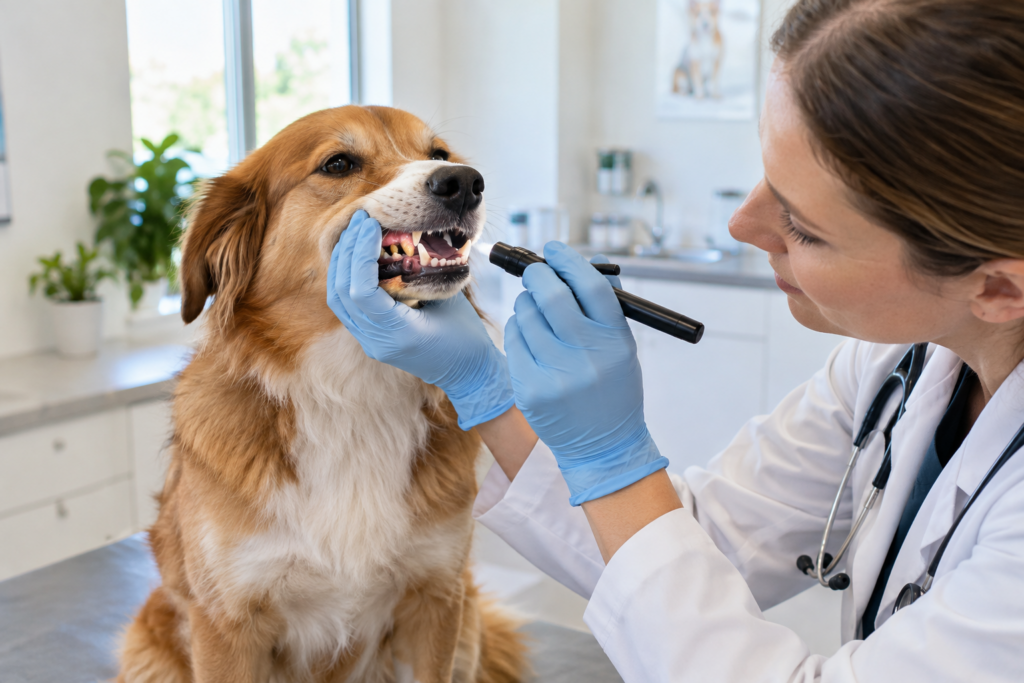
Bad breath is common in dogs, but persistent or unusually strong odor should not always be dismissed as simply part of having a dog.
If you are wondering why does my dog have bad breath, the smell itself cannot provide a diagnosis. However, ongoing or changing breath odor can be one reason to take a closer look at your dog’s oral health.
Periodontal disease is one possible contributor. Diseased or damaged teeth, infection involving a tooth, oral masses, and other conditions affecting the mouth may also play a role.
A veterinary dental examination can help determine what is happening and whether additional diagnostic evaluation may be appropriate.
Is Bad Breath Normal for Dogs?
A dog’s breath does not necessarily smell pleasant all the time, especially after eating.
What deserves more attention is odor that becomes persistent, unusually strong, noticeably different, or progressively worse.
Bad breath is a symptom rather than a diagnosis. The smell cannot tell you exactly what condition is present or how serious it may be.
It is also helpful to notice whether the breath change occurs alongside other oral or behavioral changes. Your veterinarian may want to know whether your dog has started chewing differently, drooling more, showing sensitivity around the mouth, or behaving differently while eating.
Those details can provide useful context during an examination.
What Oral Problems Can Cause Bad Breath in Dogs?
Several dental and oral conditions can potentially contribute to persistent bad breath.
Possible causes may include periodontal disease, plaque and calculus accumulation, diseased or damaged teeth, infection involving a tooth, oral masses, or other abnormalities affecting the mouth.
These conditions do not affect every dog in the same way.
One dog may have significant periodontal disease, while another may have a specific tooth problem or abnormal oral tissue that requires a different type of evaluation.
The odor alone cannot identify which condition is present.
That is why examining the mouth and evaluating the individual dog is more useful than trying to determine the cause based only on how the breath smells.
Can Periodontal Disease Cause Bad Breath?
Yes. Periodontal disease can contribute to bad breath in dogs.
Periodontal disease affects the tissues that surround and support the teeth. As changes occur around the teeth and gums, inflammation and disease within those tissues can contribute to unpleasant odor.
However, bad breath alone does not establish that a dog has periodontal disease.
A professional examination is needed to evaluate the teeth, gums, and surrounding oral structures and determine whether periodontal disease or another condition may be involved.
The practice confirms periodontal treatment as part of its specialty veterinary dental services.
Why Can My Dog Have Bad Breath Even if the Teeth Look Fine?
Not every dental or oral problem is easy to see when looking into a dog’s mouth at home.
Some conditions may involve areas beneath the gumline, the roots of the teeth, or structures that cannot be fully assessed during a simple visual inspection.
A tooth may appear relatively normal from the outside while still needing closer evaluation.
Depending on the findings from the examination, diagnostic tools such as dental radiographs or Cone Beam CT imaging may provide additional information.
Our veterinary dentistry services include dental radiographs and CBCT imaging when clinically appropriate.
These tools are not automatically necessary for every dog with bad breath. The type of diagnostic evaluation depends on the individual pet, oral findings, and medical condition.
What Other Signs Should I Watch For?
Bad breath may be the first change an owner notices, but other signs can provide useful information.
Changes worth discussing with your veterinarian may include:
- difficulty or changes in chewing
- changes in eating behavior
- increased drooling
- sensitivity around the mouth
- swelling around the face or jaw
- changes involving a particular tooth
- visible abnormalities inside the mouth
- a noticeable change in the intensity or character of the breath odor
These signs do not identify the cause on their own.
They can, however, help your veterinarian understand what has changed and what may need closer evaluation.
When Should My Dog’s Bad Breath Be Evaluated?
Persistent, unusual, or worsening bad breath is worth discussing with your veterinarian, especially when it occurs with other changes involving the mouth.
An evaluation may be particularly useful when you notice changes in chewing or eating, drooling, swelling, visible abnormalities, sensitivity, or a change involving a particular tooth.
Pet owners should not try to estimate the severity of dental disease based only on breath odor.
Some oral conditions may be more extensive than they appear from the outside, while others may require a different type of care than expected.
When a dental or oral problem is complex or requires specialized assessment, referral to a veterinary dental specialist may be appropriate.
What Happens During a Veterinary Dental Examination?
A veterinary dental evaluation begins with learning about your dog’s medical and dental history and discussing the changes you have noticed.
The veterinary dental team can then evaluate the oral structures and look for findings that may help explain the bad breath.
The specific diagnostic process depends on the patient.
If the examination suggests that more information is needed, dental radiographs or another form of advanced imaging may be recommended.
The goal is not simply to treat the odor.
The goal is to identify the dental or oral problem that may be causing it and determine what type of treatment, if any, is appropriate.
Our board-certified veterinary dentists provide specialty-level care for complex dental and oral conditions in dogs and cats.
Can a Damaged Tooth or Other Oral Problem Cause Bad Breath?
Yes. A damaged or diseased tooth can potentially contribute to abnormal breath odor.
Dogs can develop fractured teeth, diseased teeth, infections involving individual teeth, and problems affecting the tissues inside or around them.
An oral mass or other abnormal tissue can also be associated with changes in the mouth, including unusual odor.
These problems cannot be diagnosed based on smell or appearance alone.
Depending on the findings, evaluation may involve dental radiographs, CBCT imaging, or other diagnostic steps.
Treatment may also vary significantly. A diseased tooth might require extraction, root canal therapy, or another approach, while an oral mass may require a different diagnostic and treatment plan.
The recommendation should always be based on the individual pet’s condition and diagnostic findings.
Does Bad Breath Mean My Dog Needs a Dental Extraction?
Not necessarily.
Bad breath does not automatically mean that one or more teeth need to be removed.
A veterinary dental professional first needs to determine what is contributing to the odor and evaluate the affected teeth and surrounding oral tissues.
Depending on the diagnosis, treatment could involve periodontal care, dental extraction, root canal therapy, oral surgery, or another procedure. In some cases, the evaluation may lead to a different recommendation altogether.
The important point is that treatment follows diagnosis.
An extraction should not be assumed simply because a dog has strong or persistent breath odor.
What Should I Do About My Dog’s Bad Breath?
If your dog’s breath has become persistently unpleasant, unusually strong, or noticeably different, begin by discussing the change with your veterinarian.
Pay attention to any additional changes involving eating, chewing, drooling, facial appearance, individual teeth, or sensitivity around the mouth.
Avoid trying to mask persistent odor without investigating why it is happening.
Bad breath can have different underlying oral causes, and the odor itself does not tell you which condition is present.
When specialty dental evaluation is appropriate, our team can assess complex oral conditions using comprehensive examinations, individualized treatment planning, and advanced diagnostic tools when indicated.
We also work collaboratively with primary care veterinarians so that the pet’s broader medical history and individual needs can remain part of the treatment discussion. Referral-based specialty care and direct appointments when appropriate are both supported by the client profile.
If your dog has persistent bad breath or another oral concern that may require specialty evaluation, contact us to learn more about veterinary dental care